Suffering and Healing
Suffering & Healing
Suffering may change the landscape of our lives, but like the tree rooted between drought and sunrise above, healing still breaks through the cracks.
“The wound is where the light enters you.” – Rumi.
This space is for every weary soul who has walked through illness, abandonment, trauma, loss, or the long silence of God which I refer to as the “dark Night of the Soul.”
Here you will find teachings, memoir excerpts, reflections, and hard-won wisdom gathered from twenty years of living in the tension between suffering and hope.
My prayer is that these writings become a gentle lantern: something small but steady enough to guide you through the dark places.
If you have felt unseen, unheard, or misunderstood in your pain — you are not alone here.
You are held.
You are remembered.
And you are worth healing.
He is the God who SEES You!
Blessings,
Tekoa Manning
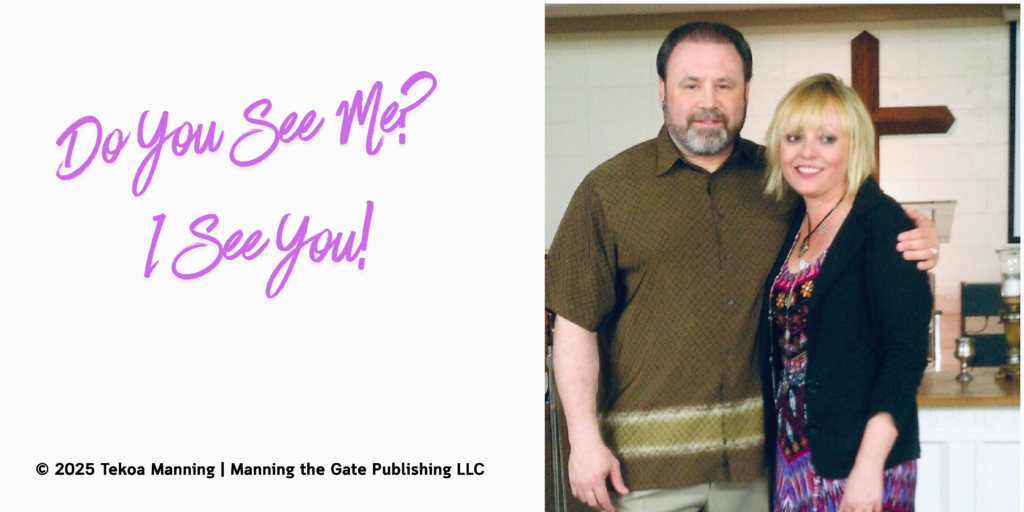
Table of Contents
Table of Contents
Do You See Me? I see You!
In seasons of deep suffering, the greatest cry of the human heart is simple:
“Does anyone see me?”
This is one of the most intimate moments in my journey — the moment God poured oil on my hands and whispered, “I SEE YOU.”
It is 2008, and I am sitting alone at a Friday night prayer meeting in a chapel. I am 40 years old and single, and the reality of my situation is starting to sink in. I can’t help but wonder, “Who would want me?” I am disabled and have lost everything I own—every title that once defined me as a person.
The evangelist concludes the prayer meeting with a call for those in need of prayer. Cane in hand, I walk to the front, joining about ten others lined up across the pulpit area. The man has a bottle of anointing oil and begins to anoint each person’s head, praying for them individually. As he prophesies over a few, he eventually gets to me. He carries out the same routine but then pauses.
“Hmm, God wants me to anoint your hands. He has a work for you involving healing.” Suddenly, hope begins to stir within me. I’ve been suffering from seizures, my legs have been buckling, my speech has been slurred, and I’ve been overwhelmed by a death-like fatigue. Now, out of nowhere, there’s hope! “He must be going to heal me!”
The minister prepares to dab oil on my hands but stops again and says, “The Father wants me to pour the entire bottle of oil over your hands.” The pastor looks at me quizzically. Turning to someone behind him, he asks for a cloth to catch the dripping oil. He then asks for my name. I feel a bit uncomfortable with all the attention. “Bonnie (Tekoa),” I reply in a whisper.
“Bonnie, can you hold out your palms?” My head is spinning, and my battle-weary soul feels like a cat that has been electrocuted. I comply and think, “How can a person with my past, my health struggles, and my brokenness ever do any ministry?” Yet, a part of me recognizes that this has been the purpose of my wilderness testing.
I acknowledge my immaturity, feeling that I might suddenly become the strong, healed woman with her own radio show, book release, and platform. I’ve been carrying around manuscripts in my laptop for years. As I hold out my small, seemingly insignificant hands and feel the oil pouring over them, it feels surreal. My mind suddenly recalls a verse:
“See how good and how pleasant it is for brothers to dwell together in unity—like the precious oil on the head, running down on the beard, the beard of Aaron, running down on the collar of his robes…”
About three years later, in 2010/2011, a man walked into the congregation where I served as the prayer director. At first sight, I found him intriguing in a good way; he was funny and shared a heartwarming story about his time ministering in a prison in South Africa alongside a friend who had traveled to speak with us.
After his message, many people came forward for prayer. Suddenly, a couple approached me with their baby, who had a heart condition. A scar ran across the infant’s tiny chest, a clear mark from a recent surgery. Their little one needed another operation and had a shunt. They wanted the South African evangelist to pray for their child. I looked at the line in front of the evangelist and then noticed Jeff Manning standing by a book table. I asked the couple if it would be okay for us to pray instead.
As I approached Jeff to see if he would join me in prayer for the baby, I found it hard to breathe or meet his gaze. I wondered what I was feeling. Then I heard the Father say, “This is your husband.” I was shocked. “This man? A police officer and pastor?” I thought I must be losing my hearing. But the Father understood what I needed and what he needed.
Our first moments together involved praying for a broken heart. How ironic that most of our ministry has revolved around just that—praying for those who are suffering. It’s hard to pray for the broken with compassion and empathy if you’ve never experienced brokenness yourself.
People with broken hearts find me, and I am so blessed that they do. As the world grows darker and love waxes colder, we need people to pray for the brokenhearted, the drug addicts, those who have been molested, the homeless, the starving, the porn addicts, and the broken women who think they cannot be forgiven for having had an abortion, for cheating on their abusive spouse, or for drinking too much daily, etc.
If you are going through the darkest night of your soul, hold out your hands and let the Holy One pour His oil on them.
Hagar felt lost, forsaken, and ashamed, but all her sorrow became a testimony. She proclaimed, “You are the God Who Sees Me!” Isn’t it wonderful to be seen? I recently spoke with a friend who was feeling down. She was identifying all the things she needed to change or work on, and then she asked, “What will I even be remembered for?”
I suggested an exercise: I would name five things she would be remembered for, and then she would name five things I would be remembered for. I highly recommend doing this exercise with someone you trust, whether it’s a seasoned friend or someone you spend a lot of time with.
As I held a mirror up to my friend, she began to weep and said things like, “I am a good mother, a loving mother who prays for my children!” Sometimes, during introspection, we need a different kind of mirror. When we love ourselves, we can love others so much more fully. I also suggest finding someone who knows you well and asking them what you need to work on. However, if you don’t know the person well, their feedback might not be constructive. It could lead to feelings of guilt, shame, or condemnation.
Hagar cherished that the God of Heaven did not only see her master, Sarai—He saw her too! He sees you as well. Even if you’ve been mistreated or cast out into the wilderness, He sees you.
As you navigate the depths of the darkest night, extend your hands upward, invite the Holy One to anoint you with His soothing balm. Let the warmth of His presence envelop you, bringing hope and healing to your weary spirit.
We all have weaknesses. Yours may look different from mine, but they are weaknesses nonetheless. Often, our weaknesses are hidden strengths. Paul said, “That is why, for Christ’s sake, I delight in weaknesses, in insults, in hardships, in persecutions, in difficulties. For when I am weak, then I am strong” (2 Corinthians 12:10).
Blessings,
Tekoa Manning
You can find my Devotionals HERE And HERE
My Husband’s Testimony — “A Police Officer & A Little Boy Named Colby”
My Husband’s Testimony, A Chapter From Thirsting for Water, A Devotional:
My husband, Jeffrey Manning, has many amazing stories about the goodness of our Father. It is his voice that closes this devotional. Grab a tissue:
At the request of my beloved wife, Tekoa, and best friend, I would like to share a walk down memory lane with you. It’s one of those memories that’s like a tapestry. The Holy One was weaving a beautiful quilt, and I was honored to be a part of it. As I start this second sentence, there are already tears in my eyes just thinking about our Abba Father’s goodness and how intricate His details are. I hope this message blesses you.
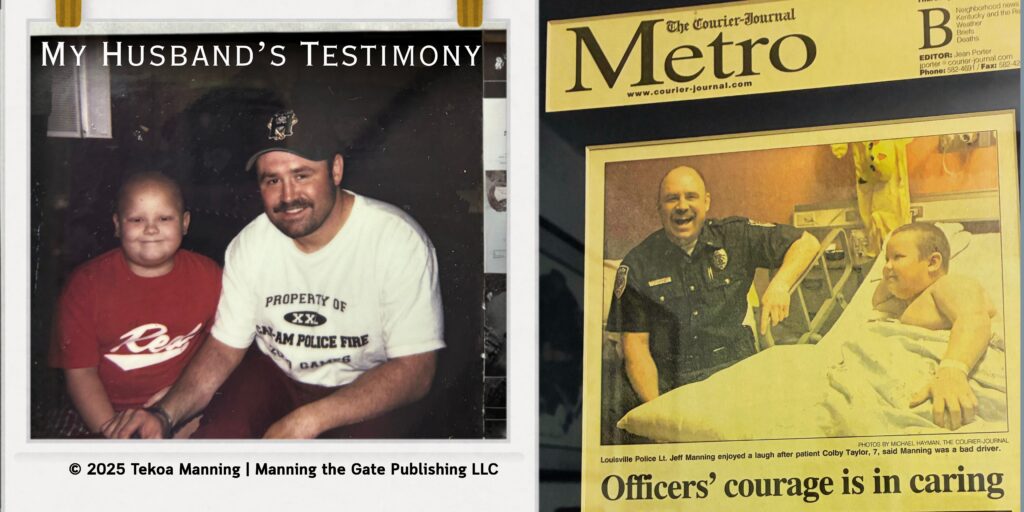
A while back, my dad called me and asked how long it had been since an article featuring a little boy named Colby and me had been published in the Metro section of the Courier-Journal Newspaper. Colby was a cancer patient at Kosair Children’s Hospital in Louisville, Kentucky. As we talked, it was hard to believe it had been over fifteen years since the publication. Weeks prior, my wife had gone through some of my old pictures and plaques to place in our office, and she had pulled the framed article out to hang above my desk.
As Dad and I continued to talk, he let me know that the Kosair Children’s Hospital Foundation had called and wanted him to come and take a tour. He wanted to see if I would accompany him. The hospital wanted to show my dad and me all the updates they had made. My dad had been faithfully giving all these years.
This testimony started months after I decided to rededicate my life to Messiah Yeshua in the mid-1990s. Following a church service, a lady approached me and told me she had a word for me from the Father. She said, “The Father has a plan for you to head up a ministry.” Further, she stated that I would be mentoring and teaching many men and for me to get spiritually prepared. I thanked her and then thought, “This lady is crazy! I am trying to get my own life straight, and now I am going to be in leadership. Yea, right lady.”
Our Father works in mysterious ways, and I soon realized that the lady in question wasn’t crazy. Within a year, two brothers in Messiah and I started the Shield of Faith Christian Police Officers Association. This entire testimony would take another chapter or two to write about. However, one facet of the ministry started about a year later when we received a call from a Crimes Against Children Detective about a young child at Kosair Children’s Hospital who would forever change our lives.
To our astonishment, a seven-year-old boy, who, along with his mother, had been traveling with the circus, grabbed a live wire that burned off three of his little fingers. The disturbing part was that his mother abandoned him at the hospital with only the clothes on his back and left with the circus, never to return. We were asked to step in. What could we do? A group of us nervously went and befriended this child, seeing him daily and bringing him clothes and toys. We could tell he hadn’t had the best of upbringings due to his choice of language at times. We did all we could and tried to shower him with our Father’s love and prayers of protection.
I will never forget the day I received a call from the hospital asking me to come down and be with this child who had lost his fingers. It was the day they would be taking off his bandages completely. After all his surgeries, the little boy would see his hand for the first time. They were worried about this being traumatic and wanted his new friends to be there with him for support. I grabbed a co-worker who was also a member of the Shield of Faith, and we headed down to the hospital.
I will never forget holding this child down as he screamed while they took off the bandages. Boy, was this kid resilient! In a couple of minutes, he was fine and ready to play. My co-worker and I drove back to headquarters in silence, with the previous events being replayed in our heads.
Simultaneously, we both started talking about how, in the world, a mother could leave their child to go through something like that all by themselves. I am thankful that this story ended well. The little boy, who was abandoned, ended up being adopted by a good family and moving on to a new life. Praise the Lord, Adonai!
Soon after, the Medical Director of Kosair Children’s Hospital approached us about regularly visiting some of the children. I remember our first meeting. We were instructed about the do’s and don’ts of what to say and not to say. How fragile some of the situations were. We realized that the primary place we were going was to the children’s unit in the cancer ward. Talk about having second thoughts. Fear began to rear its ugly head. I was nervous but felt like this was of Abba Father, as did my brothers and sisters of the Shield of Faith.
I remember being as anxious as anything as we went into the first room of the cancer unit. There was this chubby little boy introduced to us as Colby. He had no hair from the chemo treatments, but his smile lit up the room. This little fellow sat up in his bed and spoke with a country twang I will never forget.
I remember thinking about all the do’s and don’ts and thought, “What would be a safe question for Colby?” So I asked, “What do you want to be when you grow up?” He thought for a split second and said, “I want to be a Preacher.” At that very moment, I knew that the Father had sent us to do this work. I didn’t realize that Colby would preach a message to me and others that no spiritual leader ever has since.
Over the next couple of years, Colby and I developed a heavenly-ordained relationship that I will forever cherish. The Shield of Faith members and I began to visit the Hospital once a week on Wednesdays, and very seldom did we miss. The children always looked forward to the police showing up in their uniforms and coming to see them. All the kids had a soft spot in our hearts, but Colby was super special. No matter how much he was hurting, Colby always made it a point to make our day more special than we ever made his.
We were approached by the Hospital and the Courier-Journal requesting to join us during one of our visits. Out of all the rooms and all the children, they chose Colby to share in the article. Yes, He was that special.
From that article alone, we started getting a plethora of donations–not just money but toys, including police wagons to carry everything around. Another piece was done in the Southeast Christian Outlook, a local church with over 20,000 weekly in attendance. The Outlook featured Colby getting baptized in the hospital’s burn unit. Yes, Colby spread the gospel and became more of a preacher than I ever dreamed of being. He continued to touch everybody he encountered, especially me.
One day, I got the call nobody ever wanted to hear. Colby didn’t have long, and he wanted to see me. During the visit, I could not get over how brave he was. Colby asked me if he could be buried with my police handcuffs. What an honor. I remember handcuffing him and me together and letting his family take a picture of us. Two days later, I was called to Colby’s bedside, where he took his last breath minutes before I arrived.
I’m proud to say that the Chief of the Louisville Police Department allowed us to take a brand-new police car to escort Colby home to Casey County, KY. He also allowed the Shield of Faith Officers to be Colby’s Pallbearers and to play taps with the bugle. I had the honor and privilege of speaking at Colby’s funeral and placing my cuffs into his casket. This kind soul wanted to preach the gospel, and he did it better than any man I’ve seen.
I will never forget when we arrived at the cemetery. And we got out of our cars and were close to starting the service. A Donkey came over to the fence. He made the loudest noises and carried on for a couple of minutes. I remember the hairs standing up on the back of my neck. I remember thinking that the donkey braying was for Colby. After the service, two other officers with us mentioned the donkey braying loudly for Colby. The donkey was brought up several times on our ride home, and it also reminded me of the humble donkey Jesus-Yeshua rode on and the fact that our Father used a donkey to speak.
For five years, I was honored to meet and make many friends at Kosair Children’s Hospital. Again, several of these children went on to be with the Father, and others received miracles. The toys continued to pour in due to Colby, and I am proud to say that off and on for the past sixteen years, officers of the Shield of Faith have continued to make these visits, as well as my faithful dad.
Yes, Colby was a Preacher and ministered to many unknowingly. I also know that only God could have taken the broken man I was, a man who was trying to get my life back on track and place my feet on a path that would connect me with a little ole country boy named Colby, who would forever change my life.
I want to take this opportunity to thank the ones that indeed are the angels at these children’s hospitals. I want to commend the doctors, especially the nurses, who are there daily, caring for and comforting the children and their families. I pray many blessings and much comfort over these angels as they deal day in and day out with some of their new friends suffering and some passing away:
The righteous one perishes, but no one takes it to heart. Godly men are taken away, but no one discerns that the righteous man is taken from evil. He enters into shalom.
–Isaiah 57:1-2, TLV
Shop HERE

Grief, Blindness, and the One Who Heals
When you enter a hospital today, they ask you to rate your pain on a scale of 1 to 10. But what about grief? What about exhaustion?
Being tired from lack of sleep is different from being tired because your child is hungry and you have nothing to give them to eat. There is a bone-crushing tiredness that comes from chronic pain, a lack of sleep, or mental exhaustion. There’s also a weariness that comes from working overtime or from situations that seem unchanging year after year. And then there is grief.
When I was only 20 years old, I remember having a cooler with ice and a pack of bologna and cheese for my 3-year-old son. An extension cord ran across the hall from my neighbor’s apartment into mine so I could plug in a lamp for light in my living room. I listened to my son with the sweetest voice asking, “Why are there no lights in my room, Mommy?” That moment was filled with grief.
This grief lingered for over a decade and became a burden heavier than all those experiences. Genuine grief looks into the future, considering the consequences of our actions and choices and how they impact everyone around us.
Thankfully, today, this child is now a responsible provider and an even better father to two young sons who have never gone without food. However, you might want to be cautious when opening his kitchen cabinets, as food tends to fall out.
Decisions have repercussions.
According to scripture, a man who does not provide for his household is worse than an unbeliever. Addiction brings many woes, and so does pride.
Having genuine sorrow for those you love who cannot see their condition is not about pointing fingers; it’s a longing to help them cleanse their garments and obtain eye salve. However, what can be even more dire at times is recognizing our own reflection and condition for the first time—looking deeply into our walk and our thoughts.
I’m going to be honest: I’ve been walking in grief for days. The other evening, I broke down and sobbed uncontrollably over what I see. Right now, in a physical sense, I have cataracts in both eyes, yet I’m seeing more clearly than ever.
Remember when Yeshua wept over Jerusalem? As Jesus approached the city, He wept and said, “If only you had known on this day what would bring you peace! But now it is hidden from your eyes.” (Luke 19:41-42). Yeshua foresaw the destruction that would come upon His people, prophesying about 70 AD. He warned them, “For the days will come upon you when your enemies will barricade you and surround you and hem you in on every side. They will level you to the ground—you and the children within your walls. They will not leave one stone on another because you did not recognize the time of your visitation from God.”
Stoned to death… But now, not one stone remains upon another.
What a fearful condition it is to miss our visitation!
How does one discuss grief that bends you over and causes you to weep uncontrollably? Brené Brown addressed shame in a TED Talk that resonated with many, but shame and grief are two different feelings. Grief is a sorrow that takes your breath away. There are many types of grief, just as there are many layers to the phrase, “I’m tired.”
Often, people experience grief over the death of a loved one or receive a life-threatening diagnosis. However, some individuals are spiritually dead even if they are not physically buried six feet under. Many of my friends, particularly two in specific, are going through deep grief, and I struggle to find the right words to console them. The news they bear is more than one can handle; the burden is too bitter to swallow. Like Yeshua, we often wish to avoid the painful realities of death and just wish to move on.
In a world filled with gadgets, distractions, and desires for money, fame, accolades, and indulgence, it’s possible to be dead inside and not even realize it. Yeshua said, “For judgment, I have come into this world so that the blind may see and those who see may become blind.” (John 9)
This month, I am undergoing surgery on both eyes. My physical eyesight has become increasingly painful, yet strangely, my spiritual vision has sharpened, revealing painful truths.
I often think of Judah, who wanted to burn Tamar to death. Some teachers suggest that stoning was first, and then the body was neither buried properly nor cremated. Ironically, the commandments were inscribed on stone. Yeshua brings a baptism of fire, but we often resemble Judah, quick to point out the sins of those around us while ignoring our own shortcomings—our staff, ring, and tunic are in the hands of those we accuse. Those who have had to prostitute themselves to receive what they rightfully deserve—seed for the sower (Tamar).
Little children have a unique way of expressing the truth. Yeshua said, “I tell you the truth, unless you change and become like little children, you will never enter the kingdom of heaven.” (Matthew 18)
How do you become like a child, Job? How can you answer who made the storehouse for the rain or created the oceans and the horse? We pride ourselves on our knowledge, but like Job, who scraped sores with pottery while sitting in ashes, we are called to stand up and respond to Him.
“Then the LORD answered Job out of the whirlwind and said: ‘Who is this who obscures My counsel with words without knowledge? Now brace yourself like a man; I will question you, and you shall inform Me. Where were you when I laid the foundations of the earth? Tell Me, if you have understanding. Who fixed its measurements? Surely you know!’” (Job 38:1-5)
Surely we know… (sarcasm)
The greatest prophet to walk the earth was accused of being possessed by a demon. Have you faced similar charges? Those with poor vision often see only what they want to see. People with leprosy, clothed in priestly robes and adorned with long tassels, occupy the best seats and crave the admiration of others. These are the ones who accuse the Messiah of being demon-possessed.
“Now we know that You have a demon!” the Jews proclaimed. “Abraham died, and so did the prophets, yet You say that anyone who keeps Your word will never taste death. Are You greater than our father Abraham? He died, as did the prophets. Who do You claim to be?”
Jesus responded, “If I glorify Myself, My glory means nothing. The One who glorifies Me is My Father, the One of whom you say, ‘He is our God.’ You do not know Him, but I know Him. If I were to say I did not know Him, I would be a liar like you. But I do know Him, and I keep His word. Your father Abraham rejoiced at the thought of seeing My day. He saw it and was glad.”
The Jews then said to Him, “You are not yet fifty years old, and You have seen Abraham?”
“Truly, I tell you,” Jesus declared, “before Abraham was born, I am!”
At this, they picked up stones to throw at Him. But Jesus concealed Himself and went out of the temple area.
(John 8:52-59)
Jesus, or Yeshua, was hidden, and we seek Him out. We yearn for His presence and His true identity. We desire to share in fellowship with Him at His table, yet we often still carry our grief. Paul referred to this as the fellowship of His sufferings. We long for His kingdom to come because we need a Savior.
“Yeshua was hidden, and He went out of the temple.” He departs from our lives when we are disobedient, leaving us with a feeling of emptiness—a feeling that can seem most hollow. It’s a state of being like a person on the brink of death.
“Please do not take Your Spirit from me!” David pleaded.
David observed Saul, a man who could no longer hear or see clearly. He resembled the ark of the covenant that the sons of Eli treated as a magical object. When the Holy Spirit departed, He did not fight for Israel that day, resulting in the deaths of Eli’s sons in battle. This led to a birth named Ichabod—meaning “Empty,” signifying a lack of glory.
Are you feeling hungry, living off cold bologna with little light? I’ve experienced that as well!
We must stop allowing others to drain our energy; we need to go directly to the source! Let us eat the honey of life. We should fall at the Master’s feet and express our grief for the dead and the lifelessness that requires renewal within ourselves. Sit Shiva, light a candle, and weep. Let your sorrow out; it’s okay to cry. Buy gold; become blind to things that hinder your sight so you can truly see. Embrace childlike wonder and remember:
Weeping may endure for the night, but joy comes in the morning! Do you need more joy in your life? My devotional, “Jumping for Joy in the Midst of Sorrow,” can help. You can find it here!
Blessings,
Tekoa Manning
Send books that heal to your friends & family with one of my gift boxes: HERE

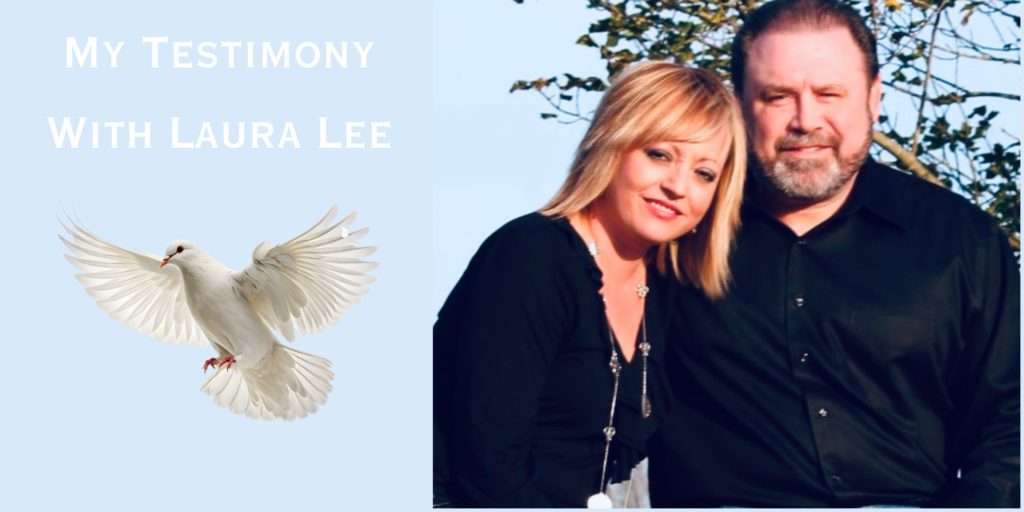
My Testimony With Laura Lee
What Can We Learn From Broken People?
Who Has A Broken Heart?
One morning in 2010, I looked into the mirror and questioned who the person staring back at me was. Financial difficulties had prevented me from getting my hair done at a salon, so a friend took me to a cosmetology school where students practice cutting hair on brave individuals seeking affordable options. I sat nervously in the chair as they applied dye to my hair and placed foils in it. Soon, I was ushered under a dryer, but I felt something running down my neck. The hair dye had seeped through the foils.
After shampooing, the stylist showed me the result: large, dark brown spots had bled and dried into my blonde hair. It looked terrible. Both her assistant and the manager came out to assess the situation.
Soon, a group of women gathered around my chair, trying to decide how to fix the mess. The manager asked if she could re-dye and cut my hair. I nodded, still in shock, as I heard the clippers start to shave the back of my head into a boyish haircut that left me with about an inch or two of hair on top, which she spiked with gel. The red dye she chose turned out to be more of a burgundy, effectively covering the dark brown spots. It was such a drastic change that I struggled to look in the mirror when it was time to go out in public.
Losing my hair was just a visible sign of deeper losses. I had lost so many things I loved so quickly that it felt like one blow would knock me to my knees, and before I could recover from that, I would be hit again. The pain I felt seemed to seep from my very being. It was as though I walked around with blood oozing from my heart. I kept trying to apply pressure to the aching spot in my heart, but it was to no avail. The weight of this pain made even breathing difficult.
I drove the short distance to the church assembly, entering with my new hairstyle, cane, and red hair. Just trying to stand during one song felt like a struggle. Although I was feeling somewhat better and could drive, I was still exhausted from chronic fatigue and other neurological issues. Losing my health felt like losing my freedom.
Everything that identified me as a person had been stripped away. I began to talk to Job as if we were old friends. I asked him, “What did it feel like when the messenger brought the news of more pain? How did you bow down and worship after hearing about the death of your children, your livestock, your servants, and the loss of your health?”
I sighed, hobbled out of the minivan, and entered the sanctuary. I tried to focus on the people around me in the pews. They smiled, clapped their hands, and sang loudly, filled with a joy that I coveted—genuine joy. I was sure that many of them had their own stories of sorrow and loss, as it seemed that was common among those I encountered.
The pastor’s message was truly needed, and many of the scriptures he quoted seemed to speak to and encourage me. He was gifted in the prophetic and humble, and I knew I was where I was supposed to be. I had only started driving this short distance to join other believers a few months ago, but sitting alone in the pew served as a painful reminder that my life had become empty.
I realized the Father had taken away my desires in more ways than one, especially when He took my husband, the man with whom I had shared my life. The Father was in control, but the pain was unbearable on some days. I missed people. I missed my pets, my stepdaughter, college, my job—life as I knew it—and yes, the man who abandoned me when I was sick. My children were living on their own or with others due to my situation. I couldn’t help but wonder how the Father could take my life and make anything good out of it again. It seemed hopeless. I was disabled, too sick to start over, and felt too empty.
I didn’t realize then that God loves empty vessels that He can fill. Elijah told the empty widow, “Go outside, borrow vessels from all your neighbors—empty vessels, and not too few” (II Kings 4:2, ESV). The widow borrowed the vessels, and the oil poured forth and filled them all. Perhaps I needed to become empty so He could pour in His oil and His Spirit and do something new in my life.
The service was nearing its end when the minister asked if anyone needed healing in their body. He glanced in my direction several times and quoted a verse from the Book of James:
“Is anyone among you sick? Let him call for the elders of the church, and let them pray over him, anointing him with oil in the name of the Lord. And the prayer of faith will save the one who is sick, and the Lord will raise him up.”
–James 5:14-15, ESV
I stood there on unsteady legs, my cane in hand, but I didn’t move from my seat. I watched as many others made their way to the altar. I listened as the minister placed his hands on the heads of those who came forward and began to pray for each one. I had often gone up for healing myself, but this time was different. My heart ached deeply. At that moment, I felt the weight of sorrow and the constant throbbing that seemed to steal my breath. It was as if my heart were a sieve, bleeding out.
“HELP!” I screamed inside my soul, pleading earnestly, “Oh Abba Father, I am sick in my body, that is true, but my heart is broken into a million pieces. Please heal my heart. Lord, can you take this grief away? IT IS MORE THAN I CAN ENDURE!”
Tears began to flow as I cried out to Him repeatedly until something profound happened—something so intimate that tears streamed down my face like unending rain. Suddenly, the minister raised the microphone to his lips and said, “I need everyone to stop for a moment. I need your attention. The Lord is telling me that there is someone here with a broken heart, and I can see it. It’s battered, bruised, and BLOODY. Where are you?” He scanned the congregation as I raised my hand—my small, seemingly insignificant hand.
He said, “People, I want you all to lay hands on our sister as we pray for the Father to heal her heart.” In that precious moment, I suddenly didn’t care about my own heart. I was in awe that the Father of glory heard me and loved me enough to speak through His minister. I was completely astonished. Abba loved me enough to stop praying over people with physical ailments to envelop me in His presence and let me know He understood my pain. He saw me and wanted to take His Son’s nail-scarred hands to hold my wounds, to pat the blood that had oozed out, and cover it with His healing blood. Oh, how I needed a Savior in more ways than one—one who is intricate and detailed. The Father spoke in a whisper that brushed across my heart and held it close to His. What a glorious Savior we serve! He does not show favoritism: “I now truly understand that God does not show favoritism” (Acts 10:34, BSB).
If you need healing from a broken heart, know that the Father wants to minister to you today. He sees your tears and desires for you to be made whole spiritually, physically, and mentally. Raise your hands to the heavens and picture His loving arms surrounding you. “He heals the brokenhearted and binds up their wounds” (Psalm 147:3, NASB).
*Question Review:*
1. How does our outer appearance sometimes affect our inward self? Can you recall a time when you drastically changed your appearance—by losing or gaining weight, experiencing hair loss, or trying a new hairstyle—that led to an inward change?
2. I was shocked when the minister paused the prayer service to speak about someone needing their heart healed. Can you think of a time when the Father surprised you?
3. In how many different ways does the Father communicate with us? Take a moment to meditate on a few.
4. In Luke 18, Yeshua tells a parable about a persistent widow. What can we learn from this story about maintaining faith and not wavering during times of great sorrow?
Then Jesus told them a parable about their need to pray at all times and not lose heart: “In a certain town, there was a judge who neither feared God nor respected men. And there was a widow in that town who kept appealing to him, ‘Give me justice against my adversary.’ For a while, he refused, but later he said to himself, ‘Though I neither fear God nor respect men, yet because this widow keeps pestering me, I will give her justice. Then she will stop wearing me out with her perpetual requests.’” And the Lord said, “Listen to the words of the unjust judge. Will not God bring about justice for His elect who cry out to Him day and night? Will He continue to defer their help? I tell you, He will promptly carry out justice on their behalf. Nevertheless, when the Son of Man comes, will He find faith on earth?”
—Luke 18:1-8, BSB
Hold on to the Word He Gave You!
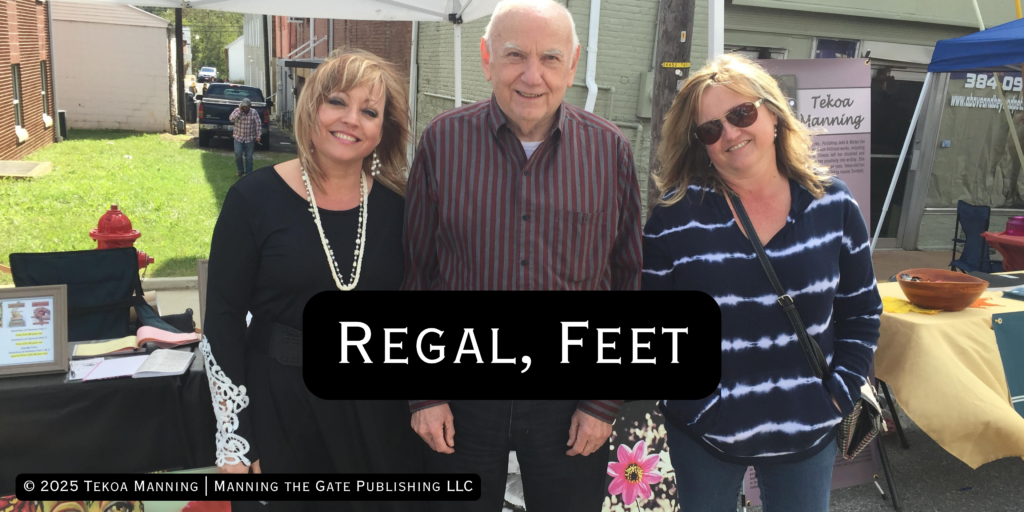
Regal, Feet
Some memories stay with us forever — not because of their grandeur, but because of the holiness found in simple moments of care. This is a story about feet, grief, anointing, hidden pain, and the unexpected places where God meets us.
Certain memories never leave us. Today, while trying to trim my toenails, I was suddenly transported back in time. I found myself at my dad’s bedside as he lay waiting to take his last breath. I had been singing hymns that he knew, ones he used to sing at the nursing home and in his congregation. He tried to sing along in hushed tones. The sheet covering him shifted, exposing one foot. His toenails were yellowed from nearly 87 years of walking this earth. Feet that had traveled to Panama, Mexico, Ecuador, and most of the States were now yellowed and scaly.
I said, “Dad, your toenails look like they could use a clipping.” He explained why it was difficult for him to manage that task, so I searched for a pair of clippers, a file, and some lotion.
After clipping and filing, we got him up in a chair, and I soaked his feet in Epsom salt and warm water. Then I went to work scrubbing away the dead skin. Afterward, he lay back in bed, exhausted from the ordeal. I sat at his bedside again and massaged his feet and legs. He said, “Oh, that feels so good.” I felt tears welling up.
As I write this now, I realize how insignificant it seems because we humans often struggle to know how to deal with those who are suffering. Those who have just received a diagnosis or the phone call in the night. Every time I saw my dad, he wore shoes or socks. I never thought to ask him about his feet.
Why don’t we do these care giving things when people are not on their deathbeds? Mainly because we don’t know what lies underneath the sheets–the shoes–the closed doors–the pain that stays bottled up inside.
Most of us have things hidden underneath sheets and shoes that need to be massaged, sanded, anointed, pruned, and moistened by His Spirit. Sometimes when these hidden things are exposed, we feel vulnerable–naked–like a failure or ashamed.
Yeshua washed feet. Repeat: The Messiah who came so we could have life-washed feet before He exited. A woman anointed His Head. A woman anointed His feet.
Luke 7:44, 45 ESV
Then turning toward the woman he said to Simon, “Do you see this woman? I entered your house; you gave me no water for my feet, but she has wet my feet with her tears and wiped them with her hair. 45 You gave me no kiss, but from the time I came in she has not ceased to kiss my feet.
The word in Hebrew for foot is regal, but there are three or four more words for feet.Our feet bring good news!!
How beautiful on the mountains are the feet of those who bring good news, who proclaim peace, who bring good tidings, who proclaim salvation, who say to Zion, “Your God reigns!”
~ Isaiah 52:7.
My dad often brought good news with his feet and did it joyfully. He cared for his wife, who had Parkinson’s, his family, those in nursing Homes, and those at his assembly. Our feet tell stories. We have ten fingers and ten toes— Ten Commandments or Ten Sayings.
“Behold, upon the mountains, the feet of him who brings good news, who publishes peace!” Nahum 1:15.
Chaim Ben Torah explains more in his teaching concerning feet.
Regal is the word used when Ruth laid at Boaz’s feet or his marglah. Here, the footgives a message of victory or power. When you see a cockroach run across the room, you will step on it with your pa’am. This is the foot that tramples down. When you step up to the podium to make an announcement, you are stepping up with your regal. Regal is spelled Resh, Gimmel Lamed. In its Semitic root, it is a picture of the power of God running to bring divine revelation. That is the word used here for feet. [1]
We can run after treasures that thieves steal, things that corrode, things moths destroy, or we can run like my dad to sing a song to shut ins, to build a church in a foreign land. To care for someone suffering.
If I were honest, sometimes, I don’t run to bring divine revelation. Sometimes my feet do not or cannot bring good news because they need washed, buffed, anointed with new oil. Sometimes, I run, bringing complaint and sorrow; other times, I step on cockroaches with my pa’am!
I remember one or two times when my feet had to run to a place at the front of the congregation. A place in Christianity often called the “altar ” and fall on my face. And I did not care who saw me. I did not care that black mascara was running down my cheeks–at that moment there was no one but me and HIM. And my Feet running.
In the past, these feet of mine have run to darkness, like the prodigal son running far away from home, but Praise the Holy One, I ran back, and He was waiting for me with a new robe, new shoes, and a new ring. If you need to make things right, you can do that right now no matter where you are. No building required, just feet ready to travel along with Jesus, Yeshua, the ANOINTED ONE. To love yourself, wash away the shame, the guilt, the unforgiveness, and fall in love again with life. Precious life.
Where have your feet been? May we kneel and tuck our feet underneath us, underneath the Messiah, bringing perfume lowly before the One who created us, and may it be a sweet smelling perfume of gratitude for all our days under the heaven.
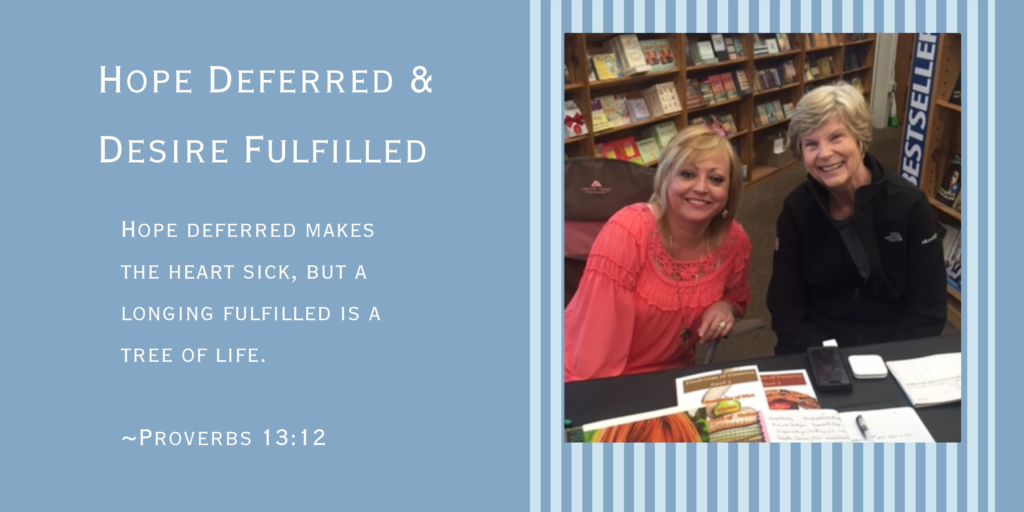
Hope Deferred & Desire Fulfilled
“Hope deferred makes the heart sick, but desire fulfilled is a tree of life” (Proverbs 13:12).
We often wait patiently for certain things to happen or come to pass. Unfortunately, at times, the things we hope for, long for, and cry out to the Holy One for do not materialize or happen when we feel they should. Occasionally, they do not happen at all. Sometimes, God withholds the desires of our hearts until we are mature enough to handle them, while other times, He waits until the circumstances resemble a stinking, rotting mess like Lazarus. When children are given everything they want whenever they want it, it leads to selfish, ungrateful adults. For example, when little Sally owns a toy box full of dolls, having one more is not a big deal. However, if you go to places of poverty in Appalachia and give a little girl there a doll, she will cherish it as if it were gold.
Something happened this week that spoke volumes of hope into my spirit. It may seem like a small thing to readers, but for me, it was a great blessing. Almost a year ago (December 2013), I wrote a letter to an English professor who changed my life. She was the first person to tell me that I could write. I entered college at 30, feeling unsure of myself and a bit self-conscious about my age and knowledge. I had just earned my G.E.D. and had recently left an abusive marriage. Glancing around the classroom at the much younger students beside me intimidated me at times. However, this professor began to speak words of encouragement into my life that would forever change its course.
I’ll refer to her as Jo. She encouraged me to enter a poetry contest, which I surprisingly won. Jo often inspired me and reassured me to keep pursuing my dreams. When I considered dropping out of school or giving up, she offered me hope. A few years later, I became too sick to finish my studies. I was too ill to work and had lost all hope. As I lay for days at a time with muscle spasms, weakness, and slurred speech, the only thing I felt I could do—ultimately the thing I was created to do—was write.
On some days, my cognitive issues made it difficult to articulate words. Still, on other days, I would lay a laptop on my belly and peck away at the keys until I had several books underway. This is where I want to talk about delayed hope. After publishing “Walter the Homeless Man,” I wrote a letter to my English professor and enclosed my novel. I was sure she would be pleased and either call me at the number I provided or perhaps send a card or a note of admiration, but nothing came.
Months went by, and I eventually forgot about reaching out to her and sending the book. After all, it had been a few years since I had seen her in person. At this point, I had given up hope of her ever responding. I felt shattered after the release of my first book in 2013, “Polishing Jade.” When my husband sent a picture of me holding my first novel to many people via text, it was met with silence—no applause, no congratulations, just mostly crickets at what should have been a celebration. I felt rejected, and since we had no marketing experience, few books sold. I questioned my gift, felt broken, and lost all hope. Why continue writing? I had no support, and I did not feel good enough.
Certain people in the Bible stand out when it comes to the theme of delayed hope. One such individual is Hannah, a young woman who cried out for a child but remained barren for many years. Joseph, too, experienced waiting, as he hoped the Cup Bearer would remember his dream interpretation and bring him out of prison. Waiting for what we hope for can often be incredibly challenging.
Almost a year has passed since then, but just two days ago, my husband brought me a card containing a two-page handwritten letter from my professor, who holds a doctorate in English literature. It turned out that my novel had been sent to the wrong campus and placed in a rarely checked mailbox. The words Jo wrote in her letter were worth more than gold to me. They were so powerful and moving that, while trying to read the letter to my husband, I had to pause several times to blow my nose, wipe my eyes, and regain my composure. That night, I lay in bed re-reading Jo’s words, and I want to share a small portion of her letter with you:
“English teachers are not allowed to say, ‘I can’t find the words to express my thoughts or emotions.’ We are supposed to believe that there are always words to convey a thought, an idea, or an image, and the challenge is for the writer to discover the language to capture those ideas. The sign of an accomplished writer is using language to express emotion and ideas as artfully as an artist uses a brush. However, in my case now, I find it difficult to discover the words to express my admiration and excitement about your writing, your book, and your exceptional accomplishment.”
She continued, “Of course, I read your book immediately when I finally connected with the package. The plot is engaging to the point that I didn’t want to stop reading in anticipation of what would happen next. The plot is so meticulously designed that it connects all the main threads, including the subplots and both major and minor characters, and it all works really well. And how wonderful that it is Christian! … I am sure that you are not interested in a critique from me, but I want you to know how proud I am of your book.”
At that moment, I realized I valued her critique more than anyone else’s because she inspired me to pick up a brush and paint a picture with words. I wondered, “Would her letter have been this sweet if it had come immediately after I submitted the book? Would she have taken the extra time and care in her letter if my package hadn’t been misplaced?” Would Samuel have meant as much to Hannah if God had filled her womb with life right when she asked for a child? Would Sarah and Abraham have cherished their child as much if it had arrived when they expected? No, it’s never as special.
I must say that whatever you aspire to do with the talents God has given you, when that moment finally arrives, it is a truly special occasion.
My husband and I often compare my books to babies. Babies need to be named and clothed, and they bring great joy. Shortly after my novel, *Walter the Homeless Man*, was published, my husband had a dream where he and I were pushing a baby stroller through a neighborhood. While there, we encountered some neighbors he knew. Surrounded by family members, Jeff, like any proud father, said to the neighbors, “This is my new baby!” At that moment, one of his family members tried to lift the baby to show it off but accidentally dropped it on its head. They rushed to catch the baby again, but unfortunately, it slipped out of their hands a second time, hitting the pavement and fracturing its skull. Our family member was horrified, repeatedly apologizing, saying they didn’t mean to drop our baby. In the dream, Jeff immediately picked up the infant, held it close, covered it, and prayed over its head.
Recently, I also had a dream. My husband and I were pushing a baby in a stroller again, but this time, the baby was covered by a blanket. The blanket concealed the baby’s face, and we appeared embarrassed to show off our new arrival. In my dream, we felt self-conscious about our baby. Then, the Father seemed to say, “Pass out cigars, open champagne, blow party streamers, and be excited about the baby I placed in your womb, for he has arrived!”
Often, when you give birth to something — a dream God has given you — the world doesn’t hold it as tightly as you do. Sometimes, the purpose of that birth isn’t even revealed until much later. Much like Joseph’s dreams shared with his siblings, our dreams can come crashing down, leading to the awe and admiration we expect from others fading away. Ultimately, God has a timing for everything; yes, His timing differs from ours. His ways are not our ways. Even the Messiah was hidden for a season.
Joseph needed two more years in prison to become humble enough to spare and save the brothers who threw him in a pit. Ultimately, Joseph and his dream interpretations ended up saving a people.
Hannah needed to reach a point where the gift of a son would be selflessly cherished.
Hold on to your dreams in the hallway. Your gift will make room for you!